

The familia is moving to Uganda, Africa, so that we can finally get our son to become part of the family. You can get the full story on our very new website: One Roof | Africa.
Thursday, October 30, 2008


Tuesday, October 14, 2008
Economic Perspective (It's Long, But Worth It).
The following is reprinted from a weekly football column I enjoy, written by the ever-intelligent Gregg Easterbrook. Yes, he writes about the NFL, but he's also a scholar at the Brookings Institute and wrote the influential-on-me book The Progress Paradox, which, if you haven't read, I encourage you to obtain immediately. Also, for the purpose of fairness, this guy is of the "(D)" political persuasion, near as I can tell.
"Financial chaos is sweeping the world," a New York Times lead story said last week. I didn't notice any chaos in my part of the world -- every business was open, ATMs were working, goods and services were plentiful. There are economic problems to be sure. But chaos? Collapse? Next Depression? Please, media and political worlds, let's stop hyperventilating and show some perspective.
What is going on is a financial panic, not an economic collapse. Financial panics are no fun, especially for anyone who needs to cash out an asset right now for retirement, college and so on. But financial panics occur cyclically and are not necessarily devastating. The most recent financial panic was 1987, when the stock market fell 23 percent in a single day. Pundits and politicians instantly began talking about another Depression, about the "end of Wall Street." The 1987 panic had zero lasting economic consequences -- no recession began, and in less than two years, stocks had recouped all losses. (See John Gordon's excellent 2004 book on the history of financial panics, "An Empire of Wealth.") Perhaps a recession will be triggered by the current financial panic, but it may not necessarily be severe.
Politicians and pundits are competing to see who can act most panicked and use the most exaggerated claims about economic crisis -- yet the fundamentals of the U.S. economy are, in fact, strong. Productivity is high; innovation is high; the workforce is robust and well-educated; unemployment is troubling at 6.1 percent, but nothing compared to the recent past, such as 11.8 percent unemployment in 1992; there are no shortages of resources, energy or goods. Here, University of Chicago economist Casey Mulligan shows that return on capital is historically high; high returns on capital are associated with strong economies. Some Americans have significant problems with mortgages, and credit availability for business could become an issue if the multiple bank-stabilizing plans in progress don't work. But the likelihood is they will work. When the 1987 panic hit, people were afraid the economy would collapse; it didn't. This panic is global, enlarging the risks. But there's a good chance things will turn out fine.
Why has a credit-market problem expanded into a panic? One reason is the media and political systems are now programmed for panic mode. Everything's a crisis! Crises, after all, keep people's eyes glued to cable news shows, so the media have an interest in proclaiming crises. Crises make Washington seem more important, and can be used to justify giveaways to favored constituent groups, so Washington influence-peddlers have an interest in proclaiming crises.
An example of the exaggerated crisis claim is the assertion that Americans "lost" $2 trillion from their pension savings in the past month, while equities "lost" $8 trillion in value. "Investors Lose $8.4 Trillion of Wealth" read a Wall Street Journal headline last week. This confuses a loss with a decline. Unless you cashed out stocks or a 401(k) in the past month, you haven't "lost" anything. Nor have most investors "lost" money, let alone $8.4 trillion -- crisis-mongering is now so deeply ingrained in the media that even Wall Street Journal headline writers have forgotten basic economics. People who because of financial need have no choice but to cash out stocks right now are really harmed. Anyone who simply holds his or her ground with stocks takes no loss and is likely, although of course not certain, to come out ahead in the end. During the housing price bubble of 2003 to 2006, many Americans became much better off on paper, but never actually sold their homes, so it was all paper gains. Right now many Americans holdings stocks or retirement plans are much worse off on paper, but will be fine so long as they don't panic and sell. One of the distressing things about last week's media cries of doomsday is that they surely caused some average people to sell stocks or 401(k)'s in panic, taking losses they might have avoided by simply doing nothing. The financial shout-shows on cable tend to advise people to buy when the market is rising, sell when the market is falling -- the worst possible advice, and last week it was amplified by panic.
We've also fallen into panic because we pay way too much attention to stock prices. Ronald Reagan said, "Never confuse the stock market with the economy." Almost everyone is now making exactly that mistake. The stock market is not a barometer of the economy; it is a barometer of what people think stocks are worth. These are entirely separate things. What people think stocks are worth now depends on their guess about what stocks will be worth in the future, which is unknowable. You can only guess, and thus optimism feeds optimism while pessimism feeds pessimism.
There is no way the American economy became 8 percent less valuable between breakfast and morning coffee break Friday, then became 3 percent more valuable at lunchtime (that is, improved by 11 percent), then became 3 percent less valuable by afternoon teatime (that is, declined by 6 percent) -- to cite the actual Dow Jones Industrials swings from Friday. And the economy sure did not become 11 percent more valuable Monday. Such swings reflect panic or herd psychology, not the underlying economy, which changes over months and years, not single days. For the past few weeks pundits and Washington and London policy-makers have been staring at stock tickers as if they provided minute-by-minute readouts of economic health, which they do not. It's embarrassing to see White House and administration officials seemingly so poorly schooled in economic theory they are obsessing over stock-price movements, which they cannot control and in the short term should not even care about.
Consider this. On Black Monday in 1987, the market fell 23 percent. If you had invested $100 in a Dow Jones Index fund the following day, it would be $460 now, a 275 percent increase adjusting for inflation. That's after the big slide of the past month, and still excellent. So don't panic, just hold your stocks. And if you'd invested $100 in real estate in 1987, it would be $240 today, a 30 percent increase adjusting for inflation. That's after the housing price bubble burst. A 30 percent real gain in 20 years isn't a great investment -- until you consider that you lived in the house or condo during this time. To purchase and live in a dwelling, then come out ahead when you sell, is everyone's dream. Not only do stocks remain a good buy, America on average is still coming out ahead on the housing dream. (This example uses the Case Shiller Index for the whole country; because housing markets are local, some homeowners have lost substantial ground while others enjoyed significant appreciation.)
Economic problems are likely to be with us for awhile, but also likely to be resolved -- the 1987 panic and the 1997 Asian currency collapse both were repaired more quickly than predicted, with much less harm than forecast. Want to worry? Worry about the fact that the United States is borrowing, mainly from foreign investors and China, the money being used to fix our banks. The worse the national debt becomes -- $11 trillion now, and increasing owing to Washington giveaways -- the more the economy will soften over the long term. It's long-term borrowing, not short-term Wall Street mood swings, that ought to worry us, because the point may be reached where we can no longer solve problems by borrowing our way out. My former Brookings Institution colleague Peter Orszag, now director of the Congressional Budget Office, was on "Newshour" last week talking about the panic. Orszag is a wicked-smart economist -- for instance, he is careful to say pension holdings have declined, not been lost like most pundits are saying, as if there were no difference between decline and loss! The below exchange occurred with host Jeffrey Brown. Remember these words:
PETER ORSZAG: One thing we need to remember is we're lucky that we have the maneuvering room now to issue lots of additional Treasury securities and intervene aggressively to address this crisis.
JEFFREY BROWN: Wait a minute. Explain that. Lucky in what sense?
PETER ORSZAG: That people are still willing to lend to us. If in 20 or 30 years we continue on the same path, with rising health-care costs and rising budget deficits, we would reach a point where we wouldn't have that ability.
Friday, September 5, 2008
Some Political Help.
[NOTE: This post has been updated considerably since I first put it up.]
God help us all if I start to write about politics on this blog, but I did feel the need to share something with you.
So much of what bothers me about our current political system is that so much of so-called "news" is really just preaching to the choir. Punditry and analysis reign on all four (FOUR!) 24-hour news networks, and rarely are we given straight-up facts to help us make up our minds. Then we have the slew of books from said pundits and analysts clogging up bookshelves. Add to that all the rhetoric from both the Ds and the Rs (and don't even get me started on talk radio) that consists primarily of saying "The other guys are bums! Vote for us!" and I'm downright disillusioned with the whole shooting match.
No one is willing to admit that anyone on their side has ever made a mistake, or that anyone from the other side has ever done anything worthwhile. It's nonstop preaching to the choir in concerted efforts to keep the contributions going, and it's turned me into a hardened, follow-the-money-on-both-sides cynic.
And then, in the midst of this, someone shared these little nuggets with me (see the links below). Basically, they are factual breakdowns of the promises made in both Barack Obama's and John McCain's acceptance speeches at their respective party conventions. People, one of these guys is going to be your President for the next four years, and whether you wholeheartedly endorse one of them or, like me, have a tough time believing either of them, you owe it to yourself and to the country you call home (if you live in the USA, that is) to at least hear them out.
My recommendation: read them both, then please--please--make up your own mind about which candidate's vision of America most closely aligns with your own. Don't let anyone else tell you how to vote, and don't turn this election into a one-issue circus. Don't say to yourself, "Well, I really love everything about that guy, except for that one pet issue I have where we don't agree, so I'm going to vote for the other guy." Please. Don't.
Let's all put aside the rhetoric and punditry and take a clear-eyed look at what the two sides are proposing, then vote according to our own senses and values.
Vote responsibly.
Obama's Promises || McCain's Promises
Note: Since whomever gets in office will be there for a solid four years, it would behoove us all to take a little extra time--an hour, maybe?--to read the full text of each of their speeches. So, with that:
Complete Obama Speech || Complete McCain Speech
And, since the VP candidates are often trotted out to say the things that the Presidential candidates want to say but can't for fear of looking bad:
Complete Biden Speech || Complete Palin Speech
[One last note: The thought dawned on me as I whacked some weeds in the backyard the other day--this is the first time in twenty-eight years that the ticket does not include the names "Bush" or "Clinton." I consider this to be a positive sign.]
Sunday, August 31, 2008
The Best Book Of 2008 (That I Didn't Write).
 I'm not too familiar with the works of N.T. Wright, but I read an article about him on Time.com, in which he discussed his newest book. I thought I'd snag it from the library and give it a once-over. I thought it sounded intriguing, but I didn't expect it to completely revolutionize the way I see my faith. This is the book that I was told The Shack would be. I couldn't resist sharing a few snippets with my vast, vast internet audience:
The power of the gospel lies not in the offer of a new spirituality or religious experience, not in the threat of hellfire (certainly not in the threat of being "left behind"), which can be removed if only the hearer checks this box, says this prayer, raises a hand, or whatever, but in the powerful announcement that God is God, that Jesus is Lord, that the powers of evil have been defeated, that God's new world has begun. This announcement, stated as fact about the way the world is rather than as an appeal about the way you might like your life, your emotions, or your bank balance to be, is the foundation of everything else. Of course, once the gospel announcement is made, in whatever way, it means instantly that all people everywhere are gladly invited to come in, to join the party, to discover forgiveness for the past, an astonishing destiny in God's future, and a vocation in the present.
I don't know about you guys, but that gets me excited. Or check out:
...What we can and must do in the present, if we are obedient to the gospel, if we are following Jesus, and if we are indwelt, energized, and directed by the Spirit, is to build for the kingdom. This brings us back to 1 Corinthians 15:58 once more: what you do in the Lord is not in vain. You are not oiling the wheels of a machine that's about to roll over a cliff. You are not restoring a great painting that's shortly going to be thrown on the fire. You are not planting roses in a garden that's about to be dug up for a building site. You are--strange though it may seem, almost as hard to believe as the resurrection itself--accomplishing something that will become in due course part of God's new world. Every act of love, gratitude, and kindness; every work of art or music inspired by the love of God and delight in the beauty of his creation; every minute spent teaching a severely handicapped child to read or to walk; every act of care and nurture, of comfort and support, for one's fellow human beings and for that matter one's fellow nonhuman creatures; and of course every prayer, all Spirit-led teaching, every deed that spreads the gospel, builds up the church, embraces and embodies holiness rather than corruption, and makes the name of Jesus honored in the world--all of this will find its way, through the resurrecting power of God, into the new creation that God will one day make. That is the logic of the mission of God. God's recreation of his wonderful world, which began with the resurrection of Jesus and continues mysteriously as God's people live in the risen Christ and in the power of his Spirit, means that what we do in Christ and by the Spirit in the present is not wasted. It will last all the way into God's new world. In fact, it will be enhanced there.
I have no idea what precisely this will mean in practice. I am putting up a signpost, not offering a photograph of what we will find once we get to where the signpost is pointing. I don't know what musical instruments we shall have to play Bach in God's new world, though I'm sure Bach's music will be there. I don't know how my planting a tree today will relate to the wonderful trees that there will be in God's recreated world, though I do remember Martin Luther's words about the proper reaction to knowing the kingdom was coming the next day being to go out and plant a tree. I do not know how the painting an artist paints today in prayer and wisdom will find a place in God's new world. I don't know how our work for justice for the poor, for remission of global debts, will reappear in that new world. But I know that God's new world of justice and joy, of hope for the whole earth, was launched when Jesus came out of the tomb on Easter morning, and I know that he calls his followers to live in him and by the power of his Spirit and so to be new-creation people here and now, bringing signs and symbols of the kingdom to birth on earth as in heaven.
Am I wrong for finding myself fascinated with this? I'll close with one more, this one about the responsibility of the Christian artist. Sound off with your thoughts below:
When we read Romans 8, we find Paul affirming that the whole of creation is groaning in travail as it longs for its redemption. Creation is good, but it is not God. It is beautiful, but its beauty is at present transient. It is in pain, but that pain is taken into the very heart of God and becomes part of the pain of new birth. The beauty of creation, to which art responds and which it tries to express, imitate, and highlight, is not simply the beauty it possesses in itself but the beauty it possesses in view of what is promised to it: ...the chalice, the violin, the engagement ring. We are committed to describing the world not just as it should be, not just as it is, but as---by God's grace alone!--one day it will be. And we should never forget that when Jesus rose from the dead, as the paradigm, first example, and generating power of the whole new creation, the marks of the nails were not just visible on his hands and his feet. They were the way he was to be identified. When art comes to terms with both the wounds of the world and the promise of the resurrection and learns how to express and respond to both at once, we will be on the way to a fresh vision, a fresh mission.
Monday, August 25, 2008
The Government Is Afraid Of The Truth!
Don't you dare attempt to correct the government's typographical errors.
Here's the lead paragraph to tantalize you into reading the story:
A man from Somerville, Mass., and his friend who went around the country this year removing typographical errors from public signs have been banned from national parks after vandalizing a historic marker at the Grand Canyon.
Friday, August 15, 2008
All The More Significant.
In light of all that's going on over in Beijing right about now, this video takes on even greater significance.
Monday, August 11, 2008
A Costa Rica Story.
[NOTE: People have been asking me to tell a story about our trip to Costa Rica. Instead of doing that, I'm going to take a shortcut and reprint here a piece I wrote for a devotional put together by my church. Enjoy.]
I love kids. Perhaps this is why I have so many of them. I love seeing the world through their eyes, or hearing them invent new ways of using language, like when my four-year-old daughter Dorothy decided that “beautiful” just wouldn’t cut it while describing a rainbow, and coined the more accurate “cute-iful.”
So yeah, I love kids a lot, especially my own. So, when we decided to go on a family missions trip to Costa Rica with Believers World Outreach this past summer, I felt great anticipation at the thought of spending time in a foreign country with my kids. This anticipation was tempered, however, by a feeling sheer panic at the thought of spending time in a foreign country with my kids.
Maybe not the “spending time” part so much as the getting there, getting around, getting all our basic needs met, and getting home parts.
Nevertheless, time marched on, and, after many generous donations from many friends, family members, and straight-up strangers, we raised the full amount we needed to get there. Before we knew it, we were in Costa Rica, all of us astounded by the natural beauty of the country.
We discovered that our children are natural travelers, and they’re very good at going with the flow. They generally ate whatever was put before them, went wherever we told them, showed up whenever they needed to be somewhere.
But the real revelation came toward the end of the trip, when we went to minister to a group of people living in an area of Jaco that everyone calls “The Riverbed.” It is a place of extreme poverty, a shanty-town erected on either side of a small river fed by the Pacific Ocean. Families live here, in ramshackle homes constructed of found materials like random doors or wooden pallets or rusted pieces of corrugated tin.
The river itself serves many purposes for this community. It is their source of water for drinking and cooking, it is their bathtub, it is their laundry room, it is their toilet. Oftentimes, it is their trash can.
We’d heard quite a bit about the Riverbed before we went, and we did our best to prepare the kids. We told them, in terms they could understand, about the poverty there, and what the kids there would look like, and generally tried to prepare them for the heart-rending images they were likely to see.
And then the strangest thing happened. We went there, and while Michelle and I were devastated by the living conditions of those in the Riverbed, our kids didn’t seem to notice. And while we were busy pitying the shabbily dressed, smudge-faced, hungry-looking children in the Riverbed, of which there are many, our kids simply approached them, smiled, waved, and began to play with them.
Simple as that.
While we adults—supposed examples to our children—were busy focusing on the differences between us and those who lived in the Riverbed, the kids looked right past that (I’m not sure if they even saw the differences in the first place) and focused on the truth of the situation:
I’m a kid. You’re a kid. Let’s play.
In faith today, especially in America, and extra-especially in this part of America, we tend to focus on the differences. We like to compare different churches, different preaching styles, different worship leaders, different song selections, different locations… we notice what makes each church different. And if we don’t like something, we can always go somewhere else.
But what if Jesus, when he told us we needed to “receive the kingdom of God like a little child” (Mark 10:15), meant that we needed to act like my kids acted in the Riverbed. What if he’s saying that, since “both Gentiles and Jews who believe the Good News share equally in the riches inherited by God’s children, (Ephesians 3:6)” then we need to stop looking at the differences between us and start looking at faith—and church—like this:
I believe in Jesus. You believe in Jesus.
Let’s play.
Thursday, August 7, 2008
Been Reading.
It's been a madhouse here at Dregs, with all kinds of behind-the-scenes monetary sizzle keeping me from my appointed rounds as a blogger. But in my spare time, I've been reading some fascinating books. To wit: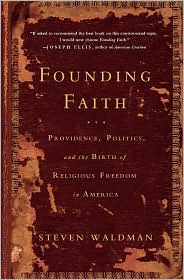 Steven Waldman, Founding Faith: Providence, Politics, and the Birth of Religious Freedom in America: What a fascinating read. Steven Waldman is the editor-in-chief of Beliefnet.com, so he's able to split the lines of demagoguery you would expect a book like this to fall along, and he's cranked out something that, I would hope, would be refreshing to people of any faith or political stripe.
Instead of starting with a viewpoint, then using the writings of the Founding Fathers to back it up, Waldman goes the other way around. He investigates history, along with the written records of Washington, Adams, Franklin, Jefferson, and Madison, to determine what these guys believed, why, and how it fit with the prevailing religiosity of the times. I tend to not read political books because they're usually all about preaching to the choir, but this one doesn't preach at all--just lays out the facts. Should be recommended reading for all schoolchildren. Perhaps I should contact Waldman and/or Random House about doing a Student Edition? It worked out so well for me in the past. Christine Kenneally, The First Word: The Search for the Origins of Language: I may not agree with all of author Christine Kenneally's assumptions (she actually says, toward the end of the book, that "evidence of design in the human body is not evidence of a Designer, but of evolution"), but this is an undeniably immersive look into the history of the spoken word. We know about the history of the written word, but when did we start speaking? What was it like? Was it a gift from On High, or did it evolve? And what about the different languages; where did they come from?
Kenneally is pretty dead-set on none of these things pointing to God at all, and she offers no concrete examples, but ultimately, I liked the book because of that. Essentially, she tracked down a bunch of scientists working in the field and posed all these types of questions to them. The answers vary, but that's part of the charm of the book--it just shows how little we actually know about our brains--and ourselves. It isn't anti-God, but you'll have to navigate past a lot of evolutionary jabber to make it through this one. If you can do that without foaming at the mouth, I recommend it.
(For the record, I've been rehashing a lot of my thoughts/beliefs about the way the world came into being. I still believe God is the designer of this world, but I have no concrete opinions on how he designed it. At this point, I'm closest to C.S. Lewis's viewpoint, presented in chapter six or so of The Problem of Pain. End of side note.) David Sedaris, When You Are Engulfed in Flames: David Sedaris is, to be blunt, a genius. The man knows how to tell a story and simultaneously wring humor, pathos, and keen observations on the human condition from a single sentence.
I first heard his literary brilliance when he made an appearance on The Late Show with David Letterman to promote his book Me Talk Pretty One Day, and he read an essay so side-splittingly hilarious that I immediately retrieved said book from the library the following day. And I was hooked.
Then I read his stuff out of order, as it was available from the library. Naked was pretty good. Holidays on Ice, with the exception of "The Santaland Diaries," was a letdown. Soon he had another collection: Dress Your Family in Corduroy & Denim, which followed in the wacky-family/crazy-childhood vein of Me Talk Pretty One Day. Hilarious stuff, but much of it shockingly vulgar.
I didn't know what to expect from this new one, but I dove in with glee. And, while the man still knows how to be funny, he's growing up. I think he's approaching fifty now, and he seems to be contemplating the inevitable conclusion that he now has less life left in the tank than he's already used. Unlike me, who's staring at the tender age of 32, Sedaris seems to be aware that the time for telling funny stories with no point is coming to an end, and the time for passing on some wisdom has arrived.
But it's still funny. For real.  Michael Chabon, Maps & Legends: Oh my. Regular Dregs readers will know I'm a sucker for Michael Chabon, but I didn't know what to expect from this, his first collection of non-fiction essays, mostly about the art of writing or just plain art. I shall cease to offer my opinions and now quote liberally from the book, starting with the first two paragraphs:
Entertainment has a bad name. Serious people learn to mistrust and even to revile it. The word wears spandex, pasties, a leisure suit studded with blinking lights. It gives off a whiff of Coppertone and dripping Creamsicle, the fake-butter miasma of movie-house lobby, of karaoke and Jagermeister, Jerry Bruckheimer movies, a Street Fighter machine grunting solipsistically in a corner of an ice-rink arcade. Entertainment trades in cliche and product placement. It engages in regions of the brain far from the centers of discernment, critical thinking, ontological speculation. It skirts the black heart of life and drowns life's lambency in a halogen glare. Intelligent people must keep a certain distance from its productions. They must handle the things that entertain them with gloves of irony and postmodern tongs. Entertainment, in short, means junk, and too much junk is bad for you--bad for your heart, your arteries, your mind, your soul.
But maybe these intelligent and serious people, my faithful straw men, are wrong. Maybe the reason for the junkiness of so much of what pretends to entertain us is that we have accepted--indeed, we have helped to articulate--such a narrow, debased concept of entertainment, sensitive at any depth, and over a wide spectrum. But we have learned to mistrust and despise our human aptitude for being entertained, and in that sense, we get the entertainment we deserve.
Wait, wait. Don't go on yet. Go back and read it again, for it is important. It is a brilliant summation of our current culture, and one with which I cannot agree more. Have you read it again, because, seriously, you should.
Okay, moving on, some thoughts about pop culture/entertainment:
The pop artisan operates within the received formulas--gangster movie, radio-ready A-side, space opera--and then incorporates into the style, manner, and mood of the work bits and pieces derived from all the aesthetic moments he or she has ever fallen in love with in other movies or songs or novels, whether hackwork or genius (without regard for and sometimes without consciousness of any difference between the two)... When it works, what you get is not a collection of references, quotes, allusions, and cribs but a whole, seamless thing, both familiar and new: a record of the consciousness that was busy falling in love with those moments in the first place. It's that filtering consciousness, coupled with the physical ability (or whatever it is) to flat-out play or song or write or draw, that transforms the fragments and jetsam and familiar pieces into something fresh and unheard of. If that sounds a lot like what flaming genius gods are supposed to be up to, then here's a distinction: the pop artisan is always hoping that, in the end, the thing is going to kill. He is haunted by a vision of pop perfection: heartbreaking beauty that moves units.
See what I mean? I need to offer no commentary; the man is a writing savant who understands his craft well. In fact, I would say that, though this book strives for greater ambition, it is the best book about writing I've read since (shockingly) Stephen King's.
The latter portions of the book are more for Chabon fans who've read his works and who would therefore be interested in learning the germs that became the ideas that became books like The Amazing Adventures of Kavalier & Clay or The Yiddish Policemen's Union. If you haven't read his work, you might be lost toward the end, but then, with gems like these, you might just find yourself entertained and inspired. I know I was:
...There is a degree to which... all literature highbrow or low, from the Aeneid onward, is fan fiction... Through parody and pastiche, allusion and homage, retelling and reimagining the stories that we were told before us and that we have come of age loving--amateurs---we proceed, seeking out the blank places in the map that our favorite writers, in their greatness and negligence, have left for us, hoping to pass on to our own readers--should we be lucky enough to find any--some of the pleasure that we ourselves have taken in the stuff we love: to get in on the game. All novels are sequels; influence is bliss.
Saturday, July 12, 2008
No Child Left Behind.
Well, we all made it, as this official photo, taken on our next-to-last day there, proves: We are back from Costa Rica, and, after a quick scan of all our available beds, I find that everyone made it back and is now asleep.
As for the trip, I have to say, it was a delightful time. Here are a few things I learned while abroad:
1) My kids are great travelers. They are very good at standing in long lines at airports that move very slowly*, and on the way there, they did a relatively whine-free job of toting all their clothes, crammed into their individual backpacks, due to our highly rational fear that the airline would lose our luggage (it happened to someone else on our team!).
2) San Jose, capital city of Costa Rica, is much bigger than I thought. And much more cosmopolitan. Being a dumb American, I was expecting ramshackle huts constructed of mud and straw. They have supermarkets!
3) Buying avocadoes the size of your head from some guy on the street? Genius.
4) I never got tired of gallo pinto for breakfast.
5) It's possible to have too much fresh pineapple. Just barely, but it's possible.
6) The people of Costa Rica are absolutely beautiful, inside and out. They are also, by and large, incredibly earnest, and my American sarcasm was lost on them. Fortunately, I know how to be funny without it.
7) The correct way to say "you're welcome" there is not "de nada," but rather "gusto."
8) Even when brewed in mass quantities with subpar water and so-so filters, Costa Rican coffee is incredible.
9) Short-term missions trips are as much about changing yourself as they are about changing the country you visit.
10) The USA is incredibly foolish for sweetening Coca-Cola with high fructose corn syrup instead of cane sugar.
11) I understand more Spanish than I thought I did. Speaking it is still a problem, though.
12) Everyone has a story to tell, and everyone has something to contribute to the cause of Christ. Even kids.
13) Charlotte's personality is her ministry.
14) Dorothy can be best friends with just about anyone, at any age.
15) Noah was born to play in the ocean. It's like every breaker is his long-lost twin.
16) Emma has the most willing missionary heart of anyone I know. The girl yearns for the lost (even though she gets humanly cranky at times).
17) Marley is great with kids who don't speak the same language as her.
18) Outside of Jesus, Michelle is the greatest thing ever to happen to me.
19) I can take a two-week break from my computer and not only not die, I can not even miss it.
20) "Por favor, depositar el papel en el basurero" is a wicked, wicked phrase, even if they do say please.
21) Americans, myself included, are far too concerned with trifles, to a troubling extent.
22) Guanabana is quite possibly the best tropical fruit you've never had.
23) Franz and Francisco are incredible bus drivers, and, should bus driving ever become an Olympic sport, will take home the gold and silver for Costa Rica. Regardless of where said Olympics are held, these two men will drive their medals back to Costa Rica on their buses. In reverse.
24) You can have some of your loudest congregational worship with just an acoustic guitar and someone playing a pulpit like a djembe.
25) Surfing is simultaneously fun, peaceful, and awe-inspiring.
26) People in Costa Rica actually say "Pura Vida" and mean it. It isn't just a tourist thing.
27) The iPod Touch costs about $550. But there is an authorized Apple Store in the mall in San Jose.
28) If you speak Spanish and aren't afraid of the walk-out, you can negotiate a super-cheap price on just about anything.
29) All kids love VBS.
30) Fly on Wednesday afternoon. There was literally no waiting at the Miami International Airport security checkpoint.
31) When in Jaco, eat at either Soda Rustico or Pachi's Pan. The former is authentic Costa Rican food for cheap, and the latter is a bakery that blows the mind. At Pachi's, order the chicken empanada (only a buck) and marvel.
32) The world needs Jesus, and the United States is not his favorite place in the whole entire earth.
That's all I can think of now. I'm sure there'll be more to come.
Thanks to all who supported us. It was truly an educational, enriching experience for every member of the Palmer Tribe, and now that we all have our passports, I tremble at the thought of where God might send us next...
*(I mean that the lines move slowly, not the airports.)
Sunday, June 22, 2008
We're Going!
Thanks to an incredibly generous public, many of our friends and family, and possibly divine intervention, we have raised enough money to pay for our Costa Rica missions trip.
We leave in three days.
I didn't realize how massive this undertaking would be until Michelle started packing for it. There are clothes upon clothes all over the place--who knew it would take so much planning and effort to shuttle two weeks' worth of clothes for seven people?
Anyway, we're all very excited (and slightly nervous) about the whole endeavor. We look forward to seeing the ways God stretches us on this trip (though I'm secretly hoping that he only stretches me in ways that are comfortable--which probably means he won't).
If I can, I'll offer some updates while abroad. I'm taking a two-week vacation from the ol' laptop, but I think there'll be a computer somewhere along the way.
Subscribe to:
Posts (Atom)