Sunday, August 31, 2008

The Best Book Of 2008 (That I Didn't Write).

I'm not too familiar with the works of N.T. Wright, but I read an article about him on Time.com, in which he discussed his newest book. I thought I'd snag it from the library and give it a once-over. I thought it sounded intriguing, but I didn't expect it to completely revolutionize the way I see my faith. This is the book that I was told The Shack would be. I couldn't resist sharing a few snippets with my vast, vast internet audience:

The power of the gospel lies not in the offer of a new spirituality or religious experience, not in the threat of hellfire (certainly not in the threat of being "left behind"), which can be removed if only the hearer checks this box, says this prayer, raises a hand, or whatever, but in the powerful announcement that God is God, that Jesus is Lord, that the powers of evil have been defeated, that God's new world has begun. This announcement, stated as fact about the way the world is rather than as an appeal about the way you might like your life, your emotions, or your bank balance to be, is the foundation of everything else. Of course, once the gospel announcement is made, in whatever way, it means instantly that all people everywhere are gladly invited to come in, to join the party, to discover forgiveness for the past, an astonishing destiny in God's future, and a vocation in the present.

I don't know about you guys, but that gets me excited. Or check out:

...What we can and must do in the present, if we are obedient to the gospel, if we are following Jesus, and if we are indwelt, energized, and directed by the Spirit, is to build for the kingdom. This brings us back to 1 Corinthians 15:58 once more: what you do in the Lord is not in vain. You are not oiling the wheels of a machine that's about to roll over a cliff. You are not restoring a great painting that's shortly going to be thrown on the fire. You are not planting roses in a garden that's about to be dug up for a building site. You are--strange though it may seem, almost as hard to believe as the resurrection itself--accomplishing something that will become in due course part of God's new world. Every act of love, gratitude, and kindness; every work of art or music inspired by the love of God and delight in the beauty of his creation; every minute spent teaching a severely handicapped child to read or to walk; every act of care and nurture, of comfort and support, for one's fellow human beings and for that matter one's fellow nonhuman creatures; and of course every prayer, all Spirit-led teaching, every deed that spreads the gospel, builds up the church, embraces and embodies holiness rather than corruption, and makes the name of Jesus honored in the world--all of this will find its way, through the resurrecting power of God, into the new creation that God will one day make. That is the logic of the mission of God. God's recreation of his wonderful world, which began with the resurrection of Jesus and continues mysteriously as God's people live in the risen Christ and in the power of his Spirit, means that what we do in Christ and by the Spirit in the present is not wasted. It will last all the way into God's new world. In fact, it will be enhanced there.

I have no idea what precisely this will mean in practice. I am putting up a signpost, not offering a photograph of what we will find once we get to where the signpost is pointing. I don't know what musical instruments we shall have to play Bach in God's new world, though I'm sure Bach's music will be there. I don't know how my planting a tree today will relate to the wonderful trees that there will be in God's recreated world, though I do remember Martin Luther's words about the proper reaction to knowing the kingdom was coming the next day being to go out and plant a tree. I do not know how the painting an artist paints today in prayer and wisdom will find a place in God's new world. I don't know how our work for justice for the poor, for remission of global debts, will reappear in that new world. But I know that God's new world of justice and joy, of hope for the whole earth, was launched when Jesus came out of the tomb on Easter morning, and I know that he calls his followers to live in him and by the power of his Spirit and so to be new-creation people here and now, bringing signs and symbols of the kingdom to birth on earth as in heaven.

Am I wrong for finding myself fascinated with this? I'll close with one more, this one about the responsibility of the Christian artist. Sound off with your thoughts below:

When we read Romans 8, we find Paul affirming that the whole of creation is groaning in travail as it longs for its redemption. Creation is good, but it is not God. It is beautiful, but its beauty is at present transient. It is in pain, but that pain is taken into the very heart of God and becomes part of the pain of new birth. The beauty of creation, to which art responds and which it tries to express, imitate, and highlight, is not simply the beauty it possesses in itself but the beauty it possesses in view of what is promised to it: ...the chalice, the violin, the engagement ring. We are committed to describing the world not just as it should be, not just as it is, but as---by God's grace alone!--one day it will be. And we should never forget that when Jesus rose from the dead, as the paradigm, first example, and generating power of the whole new creation, the marks of the nails were not just visible on his hands and his feet. They were the way he was to be identified. When art comes to terms with both the wounds of the world and the promise of the resurrection and learns how to express and respond to both at once, we will be on the way to a fresh vision, a fresh mission.

Monday, August 25, 2008

The Government Is Afraid Of The Truth!

Don't you dare attempt to correct the government's typographical errors.

Here's the lead paragraph to tantalize you into reading the story:

A man from Somerville, Mass., and his friend who went around the country this year removing typographical errors from public signs have been banned from national parks after vandalizing a historic marker at the Grand Canyon.

Friday, August 15, 2008

All The More Significant.

In light of all that's going on over in Beijing right about now, this video takes on even greater significance.

Monday, August 11, 2008

A Costa Rica Story.

[NOTE: People have been asking me to tell a story about our trip to Costa Rica. Instead of doing that, I'm going to take a shortcut and reprint here a piece I wrote for a devotional put together by my church. Enjoy.]

I love kids. Perhaps this is why I have so many of them. I love seeing the world through their eyes, or hearing them invent new ways of using language, like when my four-year-old daughter Dorothy decided that “beautiful” just wouldn’t cut it while describing a rainbow, and coined the more accurate “cute-iful.”

So yeah, I love kids a lot, especially my own. So, when we decided to go on a family missions trip to Costa Rica with Believers World Outreach this past summer, I felt great anticipation at the thought of spending time in a foreign country with my kids. This anticipation was tempered, however, by a feeling sheer panic at the thought of spending time in a foreign country with my kids.

Maybe not the “spending time” part so much as the getting there, getting around, getting all our basic needs met, and getting home parts.

Nevertheless, time marched on, and, after many generous donations from many friends, family members, and straight-up strangers, we raised the full amount we needed to get there. Before we knew it, we were in Costa Rica, all of us astounded by the natural beauty of the country.

We discovered that our children are natural travelers, and they’re very good at going with the flow. They generally ate whatever was put before them, went wherever we told them, showed up whenever they needed to be somewhere.

But the real revelation came toward the end of the trip, when we went to minister to a group of people living in an area of Jaco that everyone calls “The Riverbed.” It is a place of extreme poverty, a shanty-town erected on either side of a small river fed by the Pacific Ocean. Families live here, in ramshackle homes constructed of found materials like random doors or wooden pallets or rusted pieces of corrugated tin.

The river itself serves many purposes for this community. It is their source of water for drinking and cooking, it is their bathtub, it is their laundry room, it is their toilet. Oftentimes, it is their trash can.

We’d heard quite a bit about the Riverbed before we went, and we did our best to prepare the kids. We told them, in terms they could understand, about the poverty there, and what the kids there would look like, and generally tried to prepare them for the heart-rending images they were likely to see.

And then the strangest thing happened. We went there, and while Michelle and I were devastated by the living conditions of those in the Riverbed, our kids didn’t seem to notice. And while we were busy pitying the shabbily dressed, smudge-faced, hungry-looking children in the Riverbed, of which there are many, our kids simply approached them, smiled, waved, and began to play with them.

Simple as that.

While we adults—supposed examples to our children—were busy focusing on the differences between us and those who lived in the Riverbed, the kids looked right past that (I’m not sure if they even saw the differences in the first place) and focused on the truth of the situation:

I’m a kid. You’re a kid. Let’s play.

In faith today, especially in America, and extra-especially in this part of America, we tend to focus on the differences. We like to compare different churches, different preaching styles, different worship leaders, different song selections, different locations… we notice what makes each church different. And if we don’t like something, we can always go somewhere else.

But what if Jesus, when he told us we needed to “receive the kingdom of God like a little child” (Mark 10:15), meant that we needed to act like my kids acted in the Riverbed. What if he’s saying that, since “both Gentiles and Jews who believe the Good News share equally in the riches inherited by God’s children, (Ephesians 3:6)” then we need to stop looking at the differences between us and start looking at faith—and church—like this:

I believe in Jesus. You believe in Jesus.

Let’s play.

Thursday, August 7, 2008

Been Reading.

It's been a madhouse here at Dregs, with all kinds of behind-the-scenes monetary sizzle keeping me from my appointed rounds as a blogger. But in my spare time, I've been reading some fascinating books. To wit:

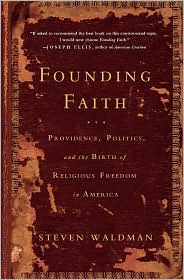
Steven Waldman, Founding Faith: Providence, Politics, and the Birth of Religious Freedom in America: What a fascinating read. Steven Waldman is the editor-in-chief of Beliefnet.com, so he's able to split the lines of demagoguery you would expect a book like this to fall along, and he's cranked out something that, I would hope, would be refreshing to people of any faith or political stripe.

Instead of starting with a viewpoint, then using the writings of the Founding Fathers to back it up, Waldman goes the other way around. He investigates history, along with the written records of Washington, Adams, Franklin, Jefferson, and Madison, to determine what these guys believed, why, and how it fit with the prevailing religiosity of the times. I tend to not read political books because they're usually all about preaching to the choir, but this one doesn't preach at all--just lays out the facts. Should be recommended reading for all schoolchildren. Perhaps I should contact Waldman and/or Random House about doing a Student Edition? It worked out so well for me in the past.


Christine Kenneally, The First Word: The Search for the Origins of Language: I may not agree with all of author Christine Kenneally's assumptions (she actually says, toward the end of the book, that "evidence of design in the human body is not evidence of a Designer, but of evolution"), but this is an undeniably immersive look into the history of the spoken word. We know about the history of the written word, but when did we start speaking? What was it like? Was it a gift from On High, or did it evolve? And what about the different languages; where did they come from?

Kenneally is pretty dead-set on none of these things pointing to God at all, and she offers no concrete examples, but ultimately, I liked the book because of that. Essentially, she tracked down a bunch of scientists working in the field and posed all these types of questions to them. The answers vary, but that's part of the charm of the book--it just shows how little we actually know about our brains--and ourselves. It isn't anti-God, but you'll have to navigate past a lot of evolutionary jabber to make it through this one. If you can do that without foaming at the mouth, I recommend it.

(For the record, I've been rehashing a lot of my thoughts/beliefs about the way the world came into being. I still believe God is the designer of this world, but I have no concrete opinions on how he designed it. At this point, I'm closest to C.S. Lewis's viewpoint, presented in chapter six or so of The Problem of Pain. End of side note.)


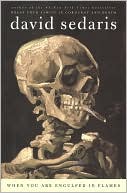
David Sedaris, When You Are Engulfed in Flames: David Sedaris is, to be blunt, a genius. The man knows how to tell a story and simultaneously wring humor, pathos, and keen observations on the human condition from a single sentence.

I first heard his literary brilliance when he made an appearance on The Late Show with David Letterman to promote his book Me Talk Pretty One Day, and he read an essay so side-splittingly hilarious that I immediately retrieved said book from the library the following day. And I was hooked.

Then I read his stuff out of order, as it was available from the library. Naked was pretty good. Holidays on Ice, with the exception of "The Santaland Diaries," was a letdown. Soon he had another collection: Dress Your Family in Corduroy & Denim, which followed in the wacky-family/crazy-childhood vein of Me Talk Pretty One Day. Hilarious stuff, but much of it shockingly vulgar.

I didn't know what to expect from this new one, but I dove in with glee. And, while the man still knows how to be funny, he's growing up. I think he's approaching fifty now, and he seems to be contemplating the inevitable conclusion that he now has less life left in the tank than he's already used. Unlike me, who's staring at the tender age of 32, Sedaris seems to be aware that the time for telling funny stories with no point is coming to an end, and the time for passing on some wisdom has arrived.

But it's still funny. For real.


Michael Chabon, Maps & Legends: Oh my. Regular Dregs readers will know I'm a sucker for Michael Chabon, but I didn't know what to expect from this, his first collection of non-fiction essays, mostly about the art of writing or just plain art. I shall cease to offer my opinions and now quote liberally from the book, starting with the first two paragraphs:

Entertainment has a bad name. Serious people learn to mistrust and even to revile it. The word wears spandex, pasties, a leisure suit studded with blinking lights. It gives off a whiff of Coppertone and dripping Creamsicle, the fake-butter miasma of movie-house lobby, of karaoke and Jagermeister, Jerry Bruckheimer movies, a Street Fighter machine grunting solipsistically in a corner of an ice-rink arcade. Entertainment trades in cliche and product placement. It engages in regions of the brain far from the centers of discernment, critical thinking, ontological speculation. It skirts the black heart of life and drowns life's lambency in a halogen glare. Intelligent people must keep a certain distance from its productions. They must handle the things that entertain them with gloves of irony and postmodern tongs. Entertainment, in short, means junk, and too much junk is bad for you--bad for your heart, your arteries, your mind, your soul.

But maybe these intelligent and serious people, my faithful straw men, are wrong. Maybe the reason for the junkiness of so much of what pretends to entertain us is that we have accepted--indeed, we have helped to articulate--such a narrow, debased concept of entertainment, sensitive at any depth, and over a wide spectrum. But we have learned to mistrust and despise our human aptitude for being entertained, and in that sense, we get the entertainment we deserve.

Wait, wait. Don't go on yet. Go back and read it again, for it is important. It is a brilliant summation of our current culture, and one with which I cannot agree more. Have you read it again, because, seriously, you should.

Okay, moving on, some thoughts about pop culture/entertainment:

The pop artisan operates within the received formulas--gangster movie, radio-ready A-side, space opera--and then incorporates into the style, manner, and mood of the work bits and pieces derived from all the aesthetic moments he or she has ever fallen in love with in other movies or songs or novels, whether hackwork or genius (without regard for and sometimes without consciousness of any difference between the two)... When it works, what you get is not a collection of references, quotes, allusions, and cribs but a whole, seamless thing, both familiar and new: a record of the consciousness that was busy falling in love with those moments in the first place. It's that filtering consciousness, coupled with the physical ability (or whatever it is) to flat-out play or song or write or draw, that transforms the fragments and jetsam and familiar pieces into something fresh and unheard of. If that sounds a lot like what flaming genius gods are supposed to be up to, then here's a distinction: the pop artisan is always hoping that, in the end, the thing is going to kill. He is haunted by a vision of pop perfection: heartbreaking beauty that moves units.

See what I mean? I need to offer no commentary; the man is a writing savant who understands his craft well. In fact, I would say that, though this book strives for greater ambition, it is the best book about writing I've read since (shockingly) Stephen King's.

The latter portions of the book are more for Chabon fans who've read his works and who would therefore be interested in learning the germs that became the ideas that became books like The Amazing Adventures of Kavalier & Clay or The Yiddish Policemen's Union. If you haven't read his work, you might be lost toward the end, but then, with gems like these, you might just find yourself entertained and inspired. I know I was:

...There is a degree to which... all literature highbrow or low, from the Aeneid onward, is fan fiction... Through parody and pastiche, allusion and homage, retelling and reimagining the stories that we were told before us and that we have come of age loving--amateurs---we proceed, seeking out the blank places in the map that our favorite writers, in their greatness and negligence, have left for us, hoping to pass on to our own readers--should we be lucky enough to find any--some of the pleasure that we ourselves have taken in the stuff we love: to get in on the game. All novels are sequels; influence is bliss.

Saturday, July 12, 2008

No Child Left Behind.

Well, we all made it, as this official photo, taken on our next-to-last day there, proves:
We are back from Costa Rica, and, after a quick scan of all our available beds, I find that everyone made it back and is now asleep.

As for the trip, I have to say, it was a delightful time. Here are a few things I learned while abroad:

1) My kids are great travelers. They are very good at standing in long lines at airports that move very slowly*, and on the way there, they did a relatively whine-free job of toting all their clothes, crammed into their individual backpacks, due to our highly rational fear that the airline would lose our luggage (it happened to someone else on our team!).
2) San Jose, capital city of Costa Rica, is much bigger than I thought. And much more cosmopolitan. Being a dumb American, I was expecting ramshackle huts constructed of mud and straw. They have supermarkets!
3) Buying avocadoes the size of your head from some guy on the street? Genius.
4) I never got tired of gallo pinto for breakfast.
5) It's possible to have too much fresh pineapple. Just barely, but it's possible.
6) The people of Costa Rica are absolutely beautiful, inside and out. They are also, by and large, incredibly earnest, and my American sarcasm was lost on them. Fortunately, I know how to be funny without it.
7) The correct way to say "you're welcome" there is not "de nada," but rather "gusto."
8) Even when brewed in mass quantities with subpar water and so-so filters, Costa Rican coffee is incredible.
9) Short-term missions trips are as much about changing yourself as they are about changing the country you visit.
10) The USA is incredibly foolish for sweetening Coca-Cola with high fructose corn syrup instead of cane sugar.
11) I understand more Spanish than I thought I did. Speaking it is still a problem, though.
12) Everyone has a story to tell, and everyone has something to contribute to the cause of Christ. Even kids.
13) Charlotte's personality is her ministry.
14) Dorothy can be best friends with just about anyone, at any age.
15) Noah was born to play in the ocean. It's like every breaker is his long-lost twin.
16) Emma has the most willing missionary heart of anyone I know. The girl yearns for the lost (even though she gets humanly cranky at times).
17) Marley is great with kids who don't speak the same language as her.
18) Outside of Jesus, Michelle is the greatest thing ever to happen to me.
19) I can take a two-week break from my computer and not only not die, I can not even miss it.
20) "Por favor, depositar el papel en el basurero" is a wicked, wicked phrase, even if they do say please.
21) Americans, myself included, are far too concerned with trifles, to a troubling extent.
22) Guanabana is quite possibly the best tropical fruit you've never had.
23) Franz and Francisco are incredible bus drivers, and, should bus driving ever become an Olympic sport, will take home the gold and silver for Costa Rica. Regardless of where said Olympics are held, these two men will drive their medals back to Costa Rica on their buses. In reverse.
24) You can have some of your loudest congregational worship with just an acoustic guitar and someone playing a pulpit like a djembe.
25) Surfing is simultaneously fun, peaceful, and awe-inspiring.
26) People in Costa Rica actually say "Pura Vida" and mean it. It isn't just a tourist thing.
27) The iPod Touch costs about $550. But there is an authorized Apple Store in the mall in San Jose.
28) If you speak Spanish and aren't afraid of the walk-out, you can negotiate a super-cheap price on just about anything.
29) All kids love VBS.
30) Fly on Wednesday afternoon. There was literally no waiting at the Miami International Airport security checkpoint.
31) When in Jaco, eat at either Soda Rustico or Pachi's Pan. The former is authentic Costa Rican food for cheap, and the latter is a bakery that blows the mind. At Pachi's, order the chicken empanada (only a buck) and marvel.
32) The world needs Jesus, and the United States is not his favorite place in the whole entire earth.

That's all I can think of now. I'm sure there'll be more to come.

Thanks to all who supported us. It was truly an educational, enriching experience for every member of the Palmer Tribe, and now that we all have our passports, I tremble at the thought of where God might send us next...


*(I mean that the lines move slowly, not the airports.)

Sunday, June 22, 2008

We're Going!

Thanks to an incredibly generous public, many of our friends and family, and possibly divine intervention, we have raised enough money to pay for our Costa Rica missions trip.

We leave in three days.

I didn't realize how massive this undertaking would be until Michelle started packing for it. There are clothes upon clothes all over the place--who knew it would take so much planning and effort to shuttle two weeks' worth of clothes for seven people?

Anyway, we're all very excited (and slightly nervous) about the whole endeavor. We look forward to seeing the ways God stretches us on this trip (though I'm secretly hoping that he only stretches me in ways that are comfortable--which probably means he won't).

If I can, I'll offer some updates while abroad. I'm taking a two-week vacation from the ol' laptop, but I think there'll be a computer somewhere along the way.

Tuesday, June 3, 2008

New Discovery: We Don't Know As Much As We Think.

We have a confluence of new discoveries made recently that are really making me ponder my existence. I'm sure this coincides with my recent purchase of The Complete C.S. Lewis Signature Classics, which in turn coincided with me checking out the official audio version of said collection from my local library.

Up first, this story about a tribe of people in Brazil/Peru that has absolutely no idea that we, this internet-connected, GMO-consuming, gas-price-worrying society, exists. Here they are, obviously feeling threatened by the noisy, enormous bird flying over them:


Follow this link for more photos and the complete story, which contains this intriguing bit:

In our overcrowded world their very future hangs in the balance. Almost all of these tribes are threatened by powerful outsiders who want their land. These outsiders - loggers, miners, cattle ranchers - are often willing to kill the tribespeople to get what they want.

Even where there is no violence, the tribes can be wiped out by diseases like the common cold to which they have no resistance.

According to Miriam Ross of Survival International, which campaigns to protect the world's remaining indigenous peoples, "These tribes represent the incredible diversity of humankind. Unless we want to condemn yet more of the earth's peoples to extinction, we must respect their choice. Any contact they have with outsiders must happen in their own time and on their own terms."

Secondly, we have this bulletin from NASA, which shows, apparently, a patch of ice uncovered by the Phoenix Mars Lander's thrusters last week:


And, from the story:

"We were expecting to find ice within two to six inches of the surface," said Peter Smith of the University of Arizona, Tucson, principal investigator for Phoenix. "The thrusters have excavated two to six inches and, sure enough, we see something that looks like ice. It's not impossible that it's something else, but our leading interpretation is ice."

(Please note that the researchers are from the University of Arizona and that this whole Mars Lander thing was not orchestrated nor sponsored by the University of Phoenix. Presumably, if there is extraterrestrial life, the boosters at U of A are hoping to make them Wildcat fans before any of the other schools can get to them.)

Jocularity aside, read these stories (and while you're at it, The World Without Us isn't a bad idea, either) and then consider this: if we didn't know about either of these things, what else do we not know, and what should that teach us about our own humility?

Thursday, April 17, 2008

A Must-Read.

My wife doesn't update her blog often, but when she does, it's always worth reading. I encourage everyone to check out this post. Heartbreaking as it might be, it is a transcription of the letter she had to write to the attorney in Africa explaining why we had to forsake our adoption process.

The letter itself is written in a very African style, in Michelle's attempt to speak to the adoption attorneys in their own Ugandan variation of the English language. But the introduction she wrote is very much her own:

I never thought it would end this way. I woke up at 4 am with the grace to write the following letter out.

I am dedicating this post to birth mothers, who loved their children so much they chose to place them with families that could care for them better than they could. Who love so deeply they are willing to hurt the rest of their lives so that their children don't. I honor you women.

Goodbye, my sweet boy. I love you this much.

I admire her bravery in acknowledging and tending the emotional wounds she's sustained in the past few months. I admire her grace and poise in the grieving process. And I admire her willingness to share our story with the rest of the world.

To paraphrase an earlier post: Life goes on. God is good.

Blessings, Brave One.

Thursday, April 10, 2008

Writing Is Easy: Clarity Is For Champions!

This is possibly my favorite Calvin & Hobbes strip ever, as it deals with not one but two of my writing pet peeves in one strip! One (the unnecessary proliferation of verbs in our culture--it's like a nuclear arms race in here) I've written about before; the other is the topic of today's entry in the fabulously successful "Writing Is Easy" entries.

Clarity.

It's something we all want, unless we're writing egghead essays to impress college professors (and even then, sometimes dense language foliage isn't welcome). And yet, so many people are downright incoherent in their written communication.

Should you strive for clarity, the solution is, I think, simple: write whatever you want, then take a step back, and edit. This, I fear, is the achilles heel of most writing today, this lack of edit. We've become accustomed to vomiting our thoughts into the internet, or into an email, or onto a Microsoft Word document, and then clicking "Send."

Stop. Wait. Look at what you've written. Read it from your audience's point of view. Does the punctuation make sense? Does it speak the same language your audience speaks? Are you shooting over their heads? Under them? Can you adjust it to be more clear? Combine sentences, perhaps? Or correct run-on sentences? Perhaps you're asking too many questions at once?

You get the point. Step back. Edit. Don't end up like this...