Showing posts with label nifty miscellany. Show all posts

Monday, May 31, 2010

Turns Out That Surfing Can Make You Shallow.

Roger Ebert wrote a splendid blog entry that sent me to this Wired story about the way we take in information from the internet, and what it does to our minds. Here's a salivary quote:

What kind of brain is the Web giving us? That question will no doubt be the subject of a great deal of research in the years ahead. Already, though, there is much we know or can surmise—and the news is quite disturbing. Dozens of studies by psychologists, neurobiologists, and educators point to the same conclusion: When we go online, we enter an environment that promotes cursory reading, hurried and distracted thinking, and superficial learning. Even as the Internet grants us easy access to vast amounts of information, it is turning us into shallower thinkers, literally changing the structure of our brain.

As an author of books (they're like an iPad, but with a different kind of pages), I've long felt that our society has become more fractured in its thinking, less able to think deeply. I see it even in myself (something that Mr. Ebert cops to as well). But the study referenced above gives an indication, possibly, as to the recent downturn in the publishing world. However, as scientists love to tell us, correlation is not causation.

Still, it's interesting to think about. And yes, I noted the irony of a story bemoaning the use of hyperlinks... using hyperlinks. In all fairness, the story originally ran in the print version of Wired, and is excerpted from a forthcoming book about this topic.

Wednesday, April 1, 2009

Nerd Humor.

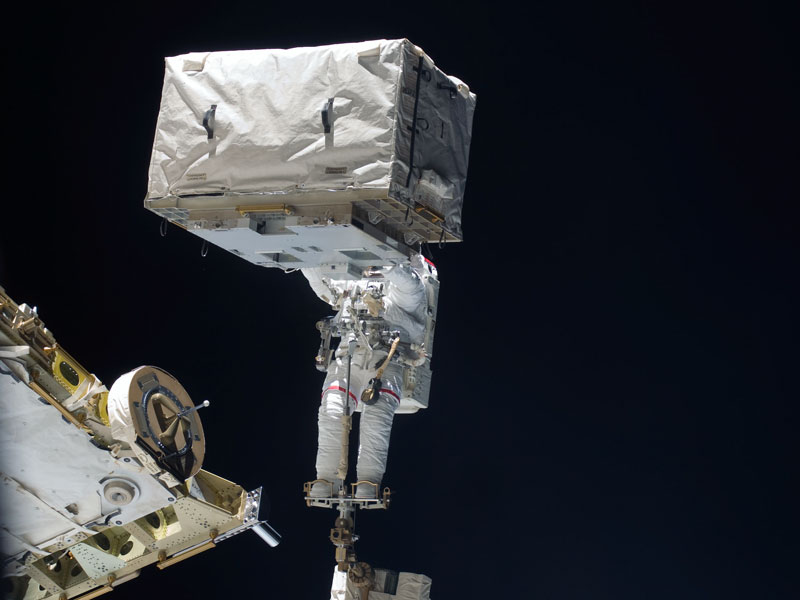
Does it make me a dork that I laughed at this April Fool's joke, borrowed from the folks at NASA? It's the last sentence that did me in.


First, a new truss was added. Then, new solar panels were installed. Now, as part of the planned upgrade of the International Space Station, an Expedition 18 astronaut has upgraded her own head. The Human Extended Analog Device 9000 was attached with only minor delays, making the astronaut's remaining spacewalks over 40 percent more efficient. With the HEAD 9000 attached, an astronaut can now directly access 4 Gigabytes of computer flash memory with their own brain, perform complex mathematics by "directed thinking", and play a pre-installed game of Tetris at no additional charge. Happy April Fools' Day from the folks at APOD. In reality, the space shuttle Discovery's mission to upgrade the International Space Station ended Saturday after upgrading only the space station. The above image of astronaut Heidemarie Stefanyshyn-Piper handling the box-like Nitrogen Tank Assembly was actually taken last November. For some reason, however, Astronaut Stefanyshyn-Piper can now factor 11 digit prime numbers in her head.

Tuesday, January 20, 2009

44.

"Let it be said by our children's children that when we were tested, we refused to let this journey end, that we did not turn back, nor did we falter; and with eyes fixed on the horizon and God's grace upon us, we carried forth that great gift of freedom and delivered it safely to future generations."

Full text here.

Thursday, January 1, 2009

Look Up.

One of the many, many side benefits that comes from moving your entire family to Uganda to adopt a child (which I'm doing, if you didn't already know), is that Jinja's lack of light pollution (the entire town pretty much goes dark when the sun goes down) means I will be able to be free to pursue one of my favorite pastimes: stargazing.

I love space. In fact, I'm such a dork, I have NASA's "Astronomy Picture of the Day" website bookmarked, and I check it every day (Yes, my gmail account, CNN.com, and the APOD are my three daily stops on the internet). I don't understand a lot of the technical stuff about space, and I'm having difficulty reconciling scientific estimates of the age of the universe with my evangelical Christian upbringing, but there's just something about looking upward that causes me to look inward.

It's comforting, oddly enough, to think that all this crazy stuff is going on out there, far away from my travails and triumphs, and simultaneously realize that I'm both very, very small and very, very loved.

2009 is the International Year of Astronomy. Take some time over the next 365 nights to look up and wonder.

Monday, August 25, 2008

The Government Is Afraid Of The Truth!

Don't you dare attempt to correct the government's typographical errors.

Here's the lead paragraph to tantalize you into reading the story:

A man from Somerville, Mass., and his friend who went around the country this year removing typographical errors from public signs have been banned from national parks after vandalizing a historic marker at the Grand Canyon.

Tuesday, June 3, 2008

New Discovery: We Don't Know As Much As We Think.

We have a confluence of new discoveries made recently that are really making me ponder my existence. I'm sure this coincides with my recent purchase of The Complete C.S. Lewis Signature Classics, which in turn coincided with me checking out the official audio version of said collection from my local library.

Up first, this story about a tribe of people in Brazil/Peru that has absolutely no idea that we, this internet-connected, GMO-consuming, gas-price-worrying society, exists. Here they are, obviously feeling threatened by the noisy, enormous bird flying over them:


Follow this link for more photos and the complete story, which contains this intriguing bit:

In our overcrowded world their very future hangs in the balance. Almost all of these tribes are threatened by powerful outsiders who want their land. These outsiders - loggers, miners, cattle ranchers - are often willing to kill the tribespeople to get what they want.

Even where there is no violence, the tribes can be wiped out by diseases like the common cold to which they have no resistance.

According to Miriam Ross of Survival International, which campaigns to protect the world's remaining indigenous peoples, "These tribes represent the incredible diversity of humankind. Unless we want to condemn yet more of the earth's peoples to extinction, we must respect their choice. Any contact they have with outsiders must happen in their own time and on their own terms."

Secondly, we have this bulletin from NASA, which shows, apparently, a patch of ice uncovered by the Phoenix Mars Lander's thrusters last week:


And, from the story:

"We were expecting to find ice within two to six inches of the surface," said Peter Smith of the University of Arizona, Tucson, principal investigator for Phoenix. "The thrusters have excavated two to six inches and, sure enough, we see something that looks like ice. It's not impossible that it's something else, but our leading interpretation is ice."

(Please note that the researchers are from the University of Arizona and that this whole Mars Lander thing was not orchestrated nor sponsored by the University of Phoenix. Presumably, if there is extraterrestrial life, the boosters at U of A are hoping to make them Wildcat fans before any of the other schools can get to them.)

Jocularity aside, read these stories (and while you're at it, The World Without Us isn't a bad idea, either) and then consider this: if we didn't know about either of these things, what else do we not know, and what should that teach us about our own humility?

Tuesday, March 4, 2008

Who Cares That They Haven't Built One Yet?


Ladies and Gentlemen, I present what could be considered the world's first green sports car.

Here's a rundown from the linked article (which has a ton of photos):

...four in-wheel motors generate 553 lb-ft of torque -- that's about as much as the tire-shredding Dodge Viper SRT produces -- and 120 kilowatts apiece (for a combined total of about 643 horsepower, putting it in the same ballpark as the Corvette ZR1). Lightning [the company who designed it] claims the car will do 0 to 60 in 4.0 seconds and hit a top speed of 130 mph. Range is 250 miles.

The car features an aluminum honeycomb chassis, carbon-kevlar bodywork, regenerative braking and 36 kilowatt nano lithium titanate battery the company says will charge in just 10 minutes and maintain 85 percent capacity after 15,000 charges. Look for a full slate of features, from anti-lock braking and traction control to air conditioning and leather.


Pretty awesome idea; here's hoping they can make it work.

Also, they're saying it'll cost $300,000. You could make this Oscar-winning movie three times with that amount of money.

Wednesday, February 6, 2008

Thoughts Turn To Space.

I recently took in the movie Sunshine, which, as I noted previously, promised to be a thinking-man's sci-fi picture that devolved in the last half-hour to a disappointing monster flick. However, because of the thinking-man's aspects of the film, I decided to revisit a couple of thinking-man's science fiction classics: 2001: A Space Odyssey, the 1972 Tarkovsky version of Solaris, widely considered a masterpiece, and Steven Soderbergh's 2002 update of the same picture.

It's interesting to me to consider the effect Star Wars had on the science fiction industry. When it was released, 2001 predated not just the Star Wars pictures, but also the moon landing. It was contemplative, in love with imagery, and eerily prescient (Roger Ebert notes that the moon in the film looks pretty much like the actual moon landing would a year later). In the same way, the '72 Solaris is contemplative (bordering on dull), in love with imagery, and full of unresolved ideas about the nature of humanity. Suddenly, along comes Star Wars five years later, and now all the space stuff is just a backdrop for a lot of swashbuckling and cool effects.

Soderbergh's Solaris was an attempt to revive that contemplative sort of sci-fi. It has no action sequences, no overwhelming mythology, no bludgeoning of the viewer's senses with ornate setpieces that feature thousands of extras (or computer-simulated extras). It's a wonderful character piece that grapples with the same themes as the original Solaris, and, unsurprisingly, it was a box office dud. Teenagers don't pay money on Friday night to see thought-provoking character pieces that, unfortunately, cost a fortune ($47 million) to produce.

All this to say, I'm starting to think more and more about the cosmos, and the human's role in it. Consider this little bit of information, lifted from, of all things, a column that appears weekly on ESPN.com:

Recently, astronomers from Middlebury College discovered one of the fastest-moving large objects ever observed, a neutron star, designated RX J0822-4300, which appears to have been hurled away from a supernova that exploded about 3,700 years ago. Using the Chandra X-ray telescope in orbit around Earth, the astronomers calculated that the neutron star is moving about 3 million miles per hour and will, over the course of time, exit the Milky Way, hurtling into the intergalactic void. The incredible speed of RX J0822-4300 offers an opportunity to put cosmic velocity and distance into perspective. Since light moves at about 671 million miles per hour, the star is traveling at slightly under one-half of 1 percent of light speed. That means the star has traversed about 20 light-years since Hammurabi was king of Babylonia. It would take the star 20 million years to cross our galaxy from one end to the other, another 350 million years to reach the next-closest galaxy to ours.

Observation of this star tells us it is physically possible to accelerate a very heavy object to a measurable fraction of light speed; some physicists had contended that might always be impossible. Now that we know it can be done, we should assume humanity someday will accomplish this artificially. So let's suppose humanity someday builds a spaceship capable of one-half of 1 percent of light speed. (The fastest manmade object so far, the New Horizons space probe currently bound for Pluto, had a peak velocity of .007 percent of light speed, meaning the neutron star is moving about 75 times faster.) If humanity someday builds a spaceship capable of moving as fast as the neutron star, such technology would open up the solar system to every conceivable shenanigan. A ship moving at half of 1 percent of the speed of light could reach Mars in about 10 hours and be at Saturn in about a day. But a spaceship moving at half of 1 percent of light speed would still be a rowboat compared with cosmic distances -- requiring 800 years to reach the nearest star to our sun and 6 million years to reach the galactic center.


This thing is big, y'all. Much bigger than our limited vision, of science fiction genre films, of humanity.

Monday, January 7, 2008

Greatest T-Shirt Ever.


The geniuses at Glarkware have done it again. First there was Good Grammar Costs Nothing, and now this. If only they didn't cost so much.

[Note: there is a bit of PG-13 language on the Glarkware site. Browse at your own risk.]

Friday, August 10, 2007

Fact: TV Makes Kids Stupider.

Don't believe me? Check out this article from Time.com, tantalizingly titled "Baby Einsteins: Not So Smart After All." I have to admit, we've plunked the tots down in front of those videos before, though I often failed to see the appeal. Still, if it was supposed to be, as Homer Simpson might put it, smartening them up, why not?

Oh, but we were wrong, says journalist Alice Park, who tosses out such tasty, guilt-inducing morsels as:

Led by Frederick Zimmerman and Dr. Dimitri Christakis, both at the University of Washington, the research team found that with every hour per day spent watching baby DVDs and videos, infants learned six to eight fewer new vocabulary words than babies who never watched the videos. These products had the strongest detrimental effect on babies 8 to 16 months old, the age at which language skills are starting to form. "The more videos they watched, the fewer words they knew," says Christakis. "These babies scored about 10% lower on language skills than infants who had not watched these videos."

...and...

Mounting evidence suggests that passive screen sucking not only doesn't help children learn, but could also set back their development. Last spring, Christakis and his colleagues found that by three months, 40% of babies are regular viewers of DVDs, videos or television; by the time they are two years old, almost 90% are spending two to three hours each day in front of a screen. Three studies have shown that watching television, even if it includes educational programming such as Sesame Street, delays language development.

...and, my favorite...

He and other experts worry that the proliferation of these products will continue to displace the one thing that babies need in the first months of life — face time with human beings. "Every interaction with your child is meaningful," says Christakis. "Time is precious in those early years, and the newborn is watching you, and learning from everything you do."

The only flaw I can find in the piece is that Park calls Sesame Street "educational," a claim I've found dubious ever since they introduced that stupid fairy character. She's cute, but I think she exists more to sell ancillary products than to teach my kids how to count to twenty. For a more incisive take on the whole business of that show, check out this flammably titled LA Times article: "Elmo Is An Evildoer."

Friday, August 3, 2007

How Many Colors Do You See?

According to this website, you see 16,777,216 colors in the above image, assuming your computer monitor settings allow it. Depending on your computer, you could be seeing as many as 16 million-plus colors...or just sixteen.

Careful. Don't get too mesmerized. You'll put your eye out.

Wednesday, July 18, 2007

"It's Called An Illusion, Michael."

Ran across this fascinating tidbit yesterday on NASA's very-good-in-a-kinda-nerdy-way Astronomy Picture of the Day website. Check out the image below:


Would you believe that the two squares labeled "A" and "B" are the exact same shade of grey? Because they are. If you're like me, you probably already looked ahead a little bit and saw this proof:


These images were created by some guy named Edward H. Adelson, and were used by some other guy, apparently for some project at MIT. At least, that's where I got this explanation from:

"The first trick is based on local contrast. In shadow or not, a check that is lighter than its neighboring checks is probably lighter than average, and vice versa. In the figure, the light check in shadow is surrounded by darker checks. Thus, even though the check is physically dark, it is light when compared to its neighbors. The dark checks outside the shadow, conversely, are surrounded by lighter checks, so they look dark by comparison.

"A second trick is based on the fact that shadows often have soft edges, while paint boundaries (like the checks) often have sharp edges. The visual system tends to ignore gradual changes in light level, so that it can determine the color of the surfaces without being misled by shadows. In this figure, the shadow looks like a shadow, both because it is fuzzy and because the shadow casting object is visible."


So, I guess that means our eyeballs and brain are just screwy, eh? Not so, says the MIT dude:

"As with many so-called illusions, this effect really demonstrates the success rather than the failure of the visual system. The visual system is not very good at being a physical light meter, but that is not its purpose. The important task is to break the image information down into meaningful components, and thereby perceive the nature of the objects in view."

Call me fascinated. If you'd like further proof that the squares are indeed the same shade of grey, click here.

Friday, April 20, 2007

Bears. Beets. Battlestar Galactica.

If you don't watch The Office, you probably won't understand this right away, but hopefully you'll find it as darn funny as I do. This is actual comedy, unlike the dreck mentioned in my last post.

Monday, April 2, 2007